Paramedic to RN: Build on the Emergency Work You Already Love
Already a paramedic or EMT? Learn how your EMS skills transfer to nursing, what RN bridge programs offer, and how to boost your salary and career options.
.webp)
Paramedics do not start from zero in nursing. You already know how to help people in urgent moments. You know how to act fast, stay calm, and keep patients safe. An RN license can build on that skill set without forcing you to give up the EMS work you value.
This blog explains why the paramedic to RN path can make sense, how your EMS skills can help, and how Achieve can support your next steps.
Quick Answers
Can a paramedic become an RN?
Yes. A paramedic can become an RN by completing an approved nursing program, meeting state rules, and passing the NCLEX-RN.
Do paramedics have to stop working in EMS if they become RNs?
No. Some paramedics earn an RN license to add more options, not to leave EMS. Depending on employer rules and state requirements, they may keep working as paramedics while also taking RN shifts.
Is becoming an RN worth it for paramedics?
For many paramedics, yes. Becoming an RN can offer stronger pay, more job choices, and more room to grow, while offering more regular schedules without so much physical exertion on the body.
And remember: Achieve is here for you. If you are a paramedic thinking about becoming an RN, we can help you compare options, prepare for key steps, and move forward with more clarity. Schedule a call with an Achieve advisor today to start planning your paramedic to RN path.
Why the Paramedic to RN Path Makes Sense for Experienced First Responders
For paramedics, becoming an RN is not always about leaving EMS. It can be about adding a stronger license to the experience you already have. You know how to assess a patient and stay steady when the moment is serious. Nursing can take that base and open new doors.
Paramedics Already Have Skills That Transfer Well to Nursing
Paramedics often bring strong care skills into nursing. EMTs and paramedics also understand the pace of urgent care, patient handoffs, and the need to stay calm when people are scared. That field experience can become a real advantage in nursing.
- Fast assessment: you can read a patient’s condition and see what needs care first.
- Calm decisions: you can stay focused when the pressure is high.
- Clear communication: you can give updates, record care, and work with the care team.
That base matters in nursing. ERs, ICUs, and trauma units all need people who can stay calm, think clearly, and act with purpose. That is why the move from paramedic to RN can feel less like starting over and more like building upward.
An RN License Can Add Options Without Taking Away Your EMS Identity
Many paramedics love being paramedics. They love the pace, purpose, teamwork, and field work. The problem is often not the job itself. It is the pay and the limited room to grow.
An RN license can help change that. It may let you keep your EMS identity while adding more ways to earn, work, and advance. As an RN, you may pursue roles such as:
- Emergency and ICU nursing: for paramedics who want to stay close to urgent care.
- Per diem or weekend ER shifts: for those who want extra income outside regular EMS hours.
- Flight or transport nursing: for those who still want field-based, high-acuity work.
For many paramedics, the move to RN is not leaving emergency care behind. It is growing what that work can become.
Paramedic vs RN: Salary, Stability, and Career Growth
For many paramedics, the choice comes down to one question: will an RN license help build a better future? Pay is not the only reason to make the move, but it is a big one. When you compare national median wages, an RN license may offer a clear pay upside.
RN Salary Potential Is Often Higher Than Paramedic Pay
The wage gap is one reason many first responders look at paramedic to RN programs. The U.S. Bureau of Labor Statistics reports that registered nurses had a higher national median annual wage than paramedics. Here’s the breakdown:
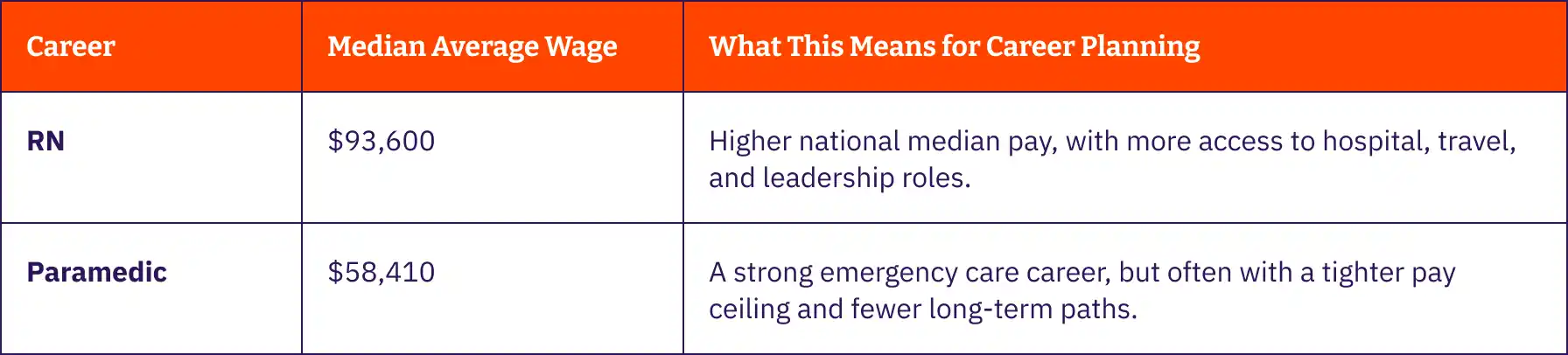
This does not mean every RN earns more than every paramedic. Pay can change by state, setting, shift, years on the job, and specialty. Still, at the national median level, an RN license offers a clear income edge.
RN Shifts Can Become a Stronger Side-Income Path
Paramedics are used to picking up extra shifts. Many work overtime, weekends, or side shifts because the work matters and the income helps. With RN licensure, some paramedics may be able to pick up ER, per diem, or weekend RN shifts while still working in EMS, depending on employer rules and state requirements.
That can make a major difference. Instead of adding more hours at the same pay level, an RN license may give you access to higher-paid shifts that still use your emergency care skills.
For paramedics who already hustle, this can be a smarter version of the same effort:
- More earning power: extra shifts may pay more at the RN level.
- More control: per diem or weekend shifts may fit around EMS work.
- More value from your experience: ER teams often need people who can think fast and handle pressure.
Flight Nursing Can Keep Paramedics Close to the Field
For paramedics who love EMS, the goal may not be to leave the field. It may be to find a higher-level role that still offers urgency, movement, teamwork, and high-stakes patient care.
Flight nursing can be one of those paths. Flight nurses often care for patients during air or ground transport, respond to serious medical needs, and work closely with paramedics, respiratory therapists, pilots, and hospital teams. For first responders who want to stay close to emergency care, this path can feel more aligned than a traditional bedside role.
An RN license may also support roles in ERs, trauma units, ICUs, and critical care transport. These settings can give paramedics a way to keep the pace and purpose they value while adding more income potential, clinical range, and long-term mobility.

Paramedic to RN Bridge Programs: How They Work and What to Expect
If you are a paramedic thinking about becoming an RN, do not rush into the first program you find. Start by learning which path fits your background, state, schedule, and goals. The right plan can help you avoid wasted time, missed steps, and extra stress.
How a Paramedic to RN Bridge Program Can Shorten Your Path to Licensure
Some nursing programs are built for licensed paramedics and may count some past EMS training. Depending on the school and state, these paths may lead to an ADN, ASN, or BSN. Still, paramedics must complete nursing courses, clinical training, and the steps needed to qualify for the NCLEX-RN.
Before choosing a program, check:
- State board approval: does the program meet RN license rules?
- Credit transfer rules: will your paramedic training count?
- Clinical requirements: what must be done in person?
How Achieve Can Help You Plan a Smarter Paramedic to RN Path
Achieve is not a nursing school. It is an education support partner that helps paramedics compare options, prepare for school steps, and move forward with more confidence.
Achieve can support you with:
- Bridge planning: see possible RN path options and next steps.
- Prerequisite and exam prep: prepare for required courses, entrance exams, or credit-by-exam options where accepted.
- 1:1 tutoring and NCLEX readiness: get support while balancing work, family, and a hard schedule.
For Achieve’s paramedic to RN bridge program, the goal is not to push you away from EMS. It is to help you use your field experience wisely, earn more options, and build a path that fits the career you want.
Ready to turn your paramedic experience into a clearer path toward RN licensure?
Achieve can help you compare options, prepare for key steps, and move forward with a plan built around your goals, schedule, and experience. Contact us today.
Take the first step
Move towards your education and career goals in less time with a more supportive, flexible program built for busy, working adults.