How to Become a Travel Nurse: RN Requirements, Licensing Steps & Best States to Work
Learn the RN license requirements, clinical experience needed, and best states for travel nursing - plus how LPNs can bridge their way there faster.
.webp)
Want a nursing career with more freedom, stronger pay potential, and the chance to work in new places? Travel nursing may be the path.
Travel nurses are licensed RNs who take short-term assignments where care teams need support. In today’s healthcare world, that can mean hospitals, clinics, long-term care centers, and crisis-response settings across different states.
Here, you’ll learn how to become a travel nurse, what education you need, how RN licensing works, why clinical experience matters, and how LPNs can move toward travel nursing through an RN bridge path.
Quick Answers
Do you need to be an RN to become a travel nurse?
Usually, yes. Most travel nurse jobs are for licensed RNs.
How much experience do you need to be a travel nurse?
Many agencies prefer 1–2 years of clinical RN experience.
Can LPNs become travel nurses?
Yes, but options are limited. Most travel assignments require an RN license. LPNs who bridge to RN open up significantly more travel opportunities.
An LPN with a clear bridge plan can reach travel nursing faster than you might think. Achieve Test Prep helps you map that path - from where you are now to RN-ready. See how →
What you actually need to become a travel nurse
Travel nursing starts with one core requirement: you need the right nursing license and enough real clinical skill to step into new settings with confidence. Most travel nurses are registered nurses who take short-term assignments, often about 8 to 13 weeks, through staffing agencies that match them with care teams that need help.
What Is a Travel Nurse and Where Do Travel Nurses Work?
A travel nurse is a licensed nurse who takes short-term assignments in places where care teams need extra support. These roles help facilities stay staffed, protect patient care, and respond to changing demand. Here’s where they commonly work:
- Hospitals: Travel nurses often support medical-surgical units, emergency departments, ICUs, labor and delivery teams, and other high-demand hospital areas.
- Clinics and outpatient centers: Some travel nurses work in primary care, specialty clinics, urgent care centers, or outpatient procedure settings.
- Long-term care and rehab facilities: Travel nurses may help skilled nursing facilities, rehab centers, and senior care teams manage staffing gaps and patient needs.
- Crisis or emergency assignments: During shortages, seasonal surges, or emergency response needs, travel nurses may step into fast-moving roles where experienced support is needed quickly.
ADN, BSN, or LPN bridge: Which Education Path Gets You There?
Most RN travel nurses start with either an ADN or BSN pathway. An ADN can be a faster route into registered nursing, while a BSN may help with broader job options in some settings. The key step is earning RN licensure and passing the NCLEX-RN. LPNs may find some travel roles, but the broader opportunity usually comes from moving from LPN to RN through a bridge pathway.
Ready to move from LPN to RN or LPN to BSN? Achieve Test Prep helps LPNs plan a faster, clearer bridge path with flexible support, test prep, and guidance through prerequisite options where accepted. If your long-term goal is a BSN, Achieve can also help you understand how an LPN to BSN pathway may fit into your next step. Discover your pathway options and start building toward travel nursing with a smarter plan.
Travel Nurse Licensing: Compact Licenses, Endorsement & State Rules
Licensing is one of the biggest differences between staff nursing and travel nursing. Because travel nurses often work across state lines, they need to know where their RN license allows them to practice, when a compact license helps, and when a separate state license is required.
Do Travel Nurses Need a Compact Nursing License?
Not always, but a compact nursing license can make travel nursing much easier. The Nurse Licensure Compact allows eligible nurses who live in a compact state to hold one multistate license and practice in other compact states. This can help travel nurses accept assignments faster in states such as Texas, Florida, and New Jersey, which participate in the compact. For the full 2026 compact state list, visit the Nurse Licensure Compact guide.
Compact vs Non-Compact States: What Travel Nurses Need to Know
Not every travel nursing assignment is covered by a compact license. If you want to work in a non-compact state, or if you do not qualify for a multistate license, you may need to apply for license by endorsement. This means the new state reviews your existing RN license, background check, education, and verification details before allowing you to practice there. For travel nurses, this step matters because licensing delays can slow down or even cost you an assignment.
Here’s how the main licensing situations usually break down:
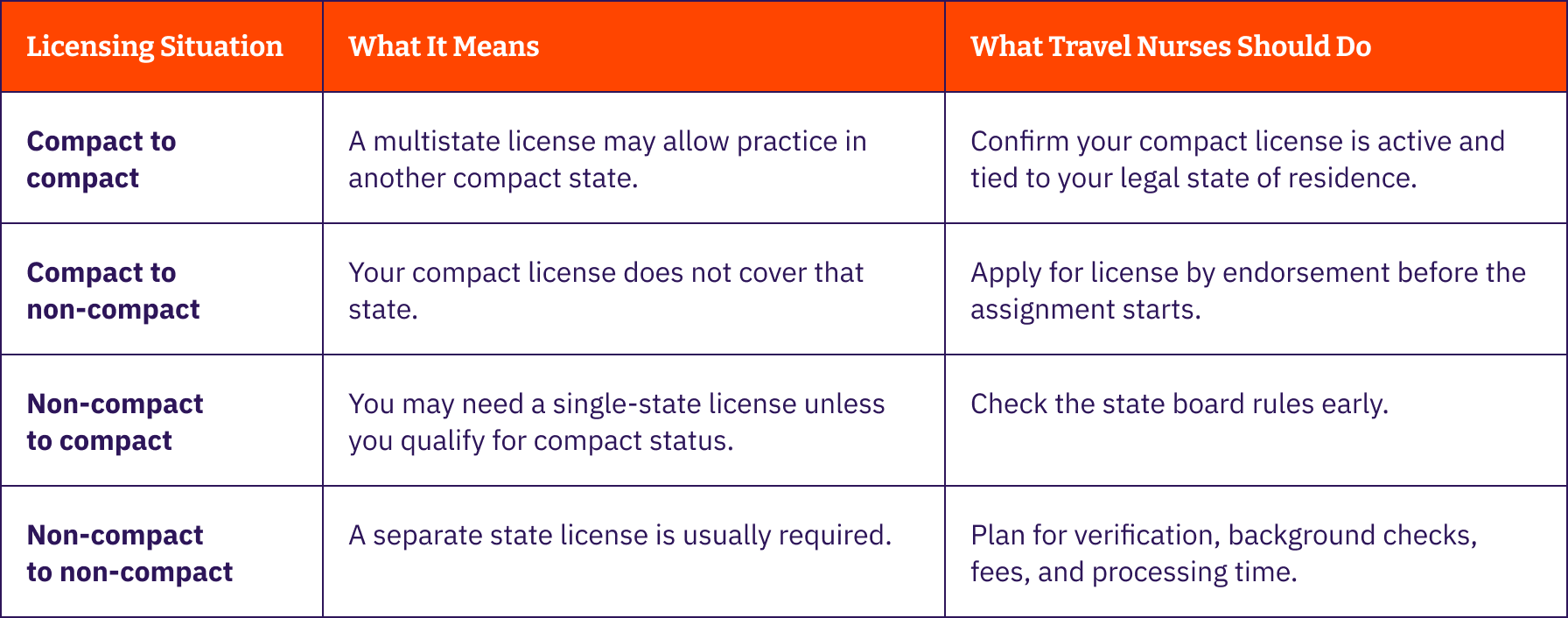
Each state board of nursing can set its own steps for endorsement, background checks, and license verification. Planning early matters because a delayed license can mean a delayed assignment.

Best Path to Travel Nursing: Timeline, Salary & Best States
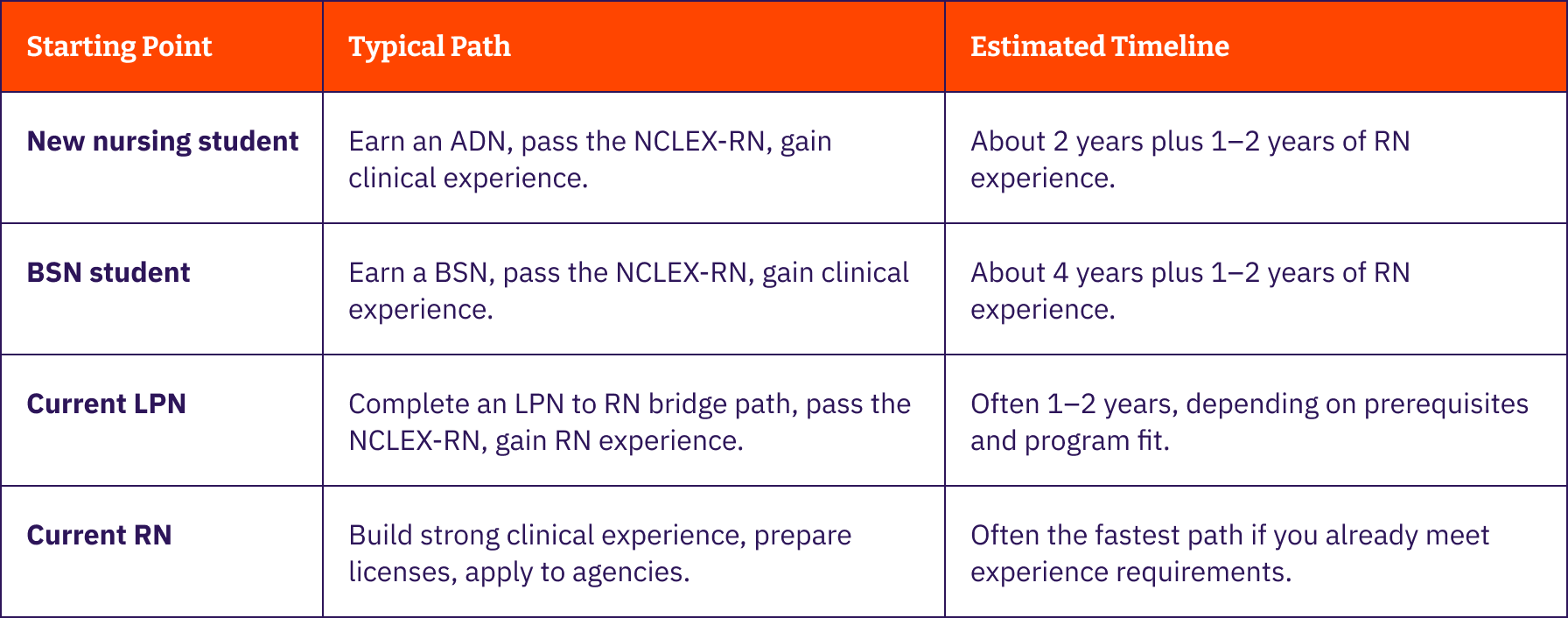
The best path to travel nursing depends on where you are starting now. A new nursing student, an LPN, and a working RN will each have a different timeline. The goal is the same: become eligible, licensed, experienced, and ready to accept assignments without delays.
How Long Does It Take to Become a Travel Nurse?
The timeline to become a travel nurse depends on your current starting point. Some students need to complete an RN program first, while LPNs may be able to use a bridge pathway and current RNs may already be close to agency-ready. The table below shows the clearest route for each starting point.
What Travel Nurses Earn and How to Choose Your First Assignment Wisely
Travel nurse pay can vary widely, but current national job data puts average travel RN pay at about $2,167 per week, with many contracts falling around $90,000–$110,000 per year when worked consistently. Higher-demand states, crisis contracts, and specialty roles can push earnings above that range. Here are some first assignments tips to keep in mind:
- Understand the weekly pay model. Travel nurse compensation may include base hourly pay, housing stipends, meal stipends, overtime, completion bonuses, and shift differentials. This is why two contracts with the same hourly rate can have very different take-home value.
- Look beyond the highest number. California, New York, Texas, and Florida can all offer strong travel nursing opportunities, but the “best” state depends on demand, cost of living, taxes, license rules, and assignment length.
- Compare pay against real expenses. A high weekly contract in California or New York may look great, but housing and daily costs can reduce the advantage. A lower weekly contract in Texas or Florida may still be attractive if expenses are lower.
- Choose your first assignment strategically. Start with a reputable agency, keep every license and document updated, stay flexible on location, and choose a role that matches your strongest clinical experience. Your first assignment should build confidence, not throw you into chaos.
Ready to build a smarter path toward travel nursing?
Achieve Test Prep helps working nurses move toward RN licensure with flexible bridge support, test prep, and guidance through prerequisite options where accepted. Learn more about your LPN to RN or LPN to BSN pathway today and take the next step toward a more flexible nursing future.
Take the next step
Move towards your education and career goals in less time with a more supportive, flexible program built for busy, working nurses.