RN vs PRN: What’s the Difference?
Are you wondering about the terms RN and PRN? These are common terms in the healthcare field. Learn the key differences between a Registered Nurse and PRN nursing positions, including variations in schedules, pay, responsibilities, and career paths.

If you’re exploring a career in nursing or even if you’re already working in healthcare, you’re likely to come across the terms RN and PRN. While they may seem similar, these terms actually refer to two completely different things in the healthcare field.
In this article, you’ll learn: what RN means, what PRN means, how the terms differ, and when you might use each one in a healthcare setting. Let’s dive in…
What is an RN?
Most people, even those not currently in the healthcare world, know that RN stands for Registered Nurse. This is a professional designation and nursing license within the healthcare system.
Registered nurses are licensed professionals who have completed an Associate Degree in Nursing or Bachelor of Science in Nursing and passed the NCLEX-RN to obtain a license to practice in their state. These nurses provide patient care, coordinate treatment plans, educate patients and family members, and collaborate with doctors and other medical staff.
What does PRN mean in nursing?
Contrary to popular belief, PRN is not a type of nurse. It comes from the Latin phrase “pro re nata” which means “as needed”, and it refers to a work schedule or employment status within the healthcare system.
A nurse working PRN only works when the healthcare facility needs additional staff. Instead of having a regular schedule, PRN nurses fill in for staff shortages, vacations, higher than normal patient numbers, and during times of seasonal demand.
PRN shifts can occur in the same settings where full time RNs already work, including hospitals, outpatient clinics, long-term care facilities, and other locations.
What’s the difference between RN and PRN?
Because RN refers to a type of nursing license and PRN refers to a work schedule, they are not mutually exclusive. In fact, most PRN nurses are also licensed RNs. A nurse can be a full time RN, a part time RN, or a PRN RN.
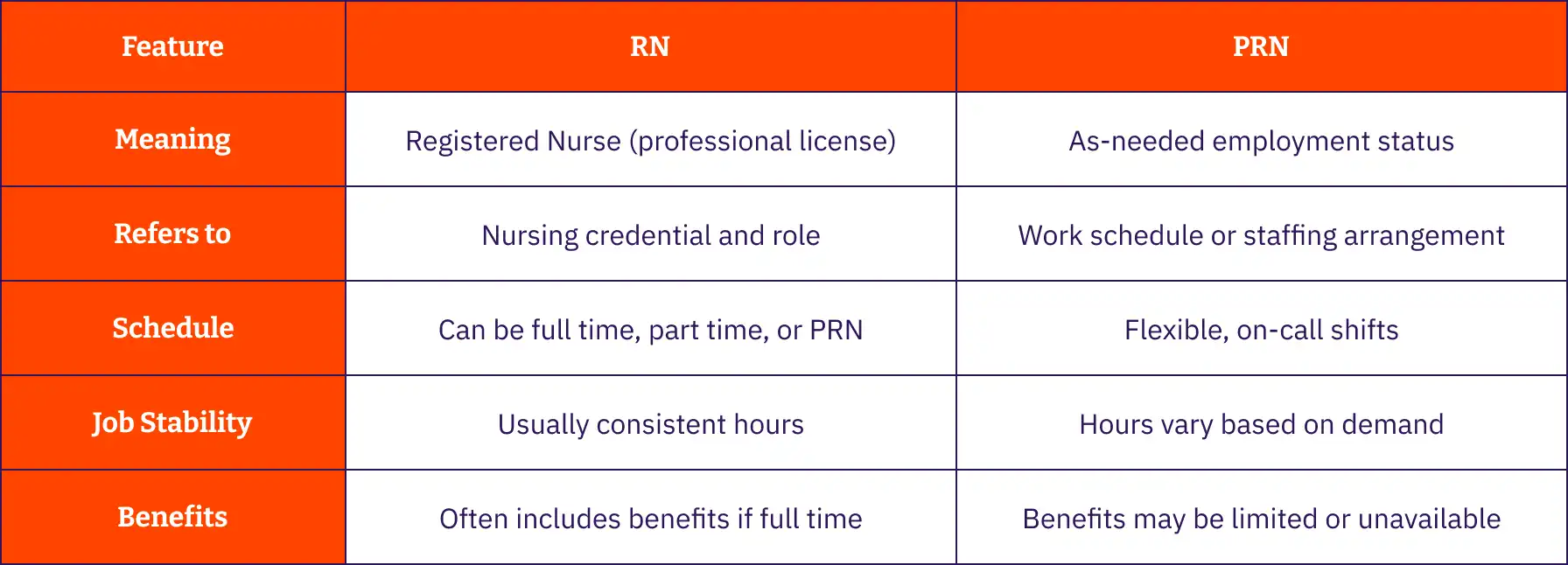
Here’s a simple comparison:
Benefits of working PRN as a nurse
Many nurses choose to work PRN because it offers a lot of flexibility. PRN nurses also enjoy a higher salary than full time or part time RNs, as well as more variety in their work environment.
Flexible scheduling
PRN nurses can select shifts that fit their lifestyle which is ideal for nurses with family responsibilities, those working to advance their education in an LPN to RN or RN to BSN bridge program, and nurses who want to enjoy a better work-life balance.
Higher hourly pay
As stated in the table above, PRNs do not typically receive benefits. Because of this, facilities often provide higher hourly rates to attract much-needed staff members.
Work environment variety
PRN nurses can work in multiple departments and even facilities, allowing them to gain broader clinical experiences.
Drawbacks to working as a PRN nurse
While there are a lot of advantages to working as a PRN nurse, there are also some potential drawbacks. PRN nurses have inconsistent hours, limited benefits, and less job security.
Inconsistent hours
PRN shifts depend on staffing needs and facility demand. This means income can vary widely from week to week, especially in more remote locations.
Limited benefits
PRN nurse positions may not include health insurance, retirement plans or paid time off. It’s important to consider the absence benefits when negotiating salary.
Less job stability
As mentioned, PRN nurses are only scheduled as needed. This means they have less predictable employment compared with full time or even part time nursing roles.
When PRN work makes sense for nurses
Despite the potential drawbacks, PRN roles can be an ideal solution for some nurses. Many nurses start their careers in full time roles and gain experience before transitioning to PRN nurse positions later in their careers.
Nurses who may want to consider a PRN nursing role:
- Nurses with more experience who want control over their schedule
- Nurses transitioning between jobs
- Nurse balancing family responsibilities
- Nursing working toward more advanced degrees
- Nurses who are retired but still want occasional shifts
Starting the path to becoming an RN
Understanding both RN and PRN terms, including what they mean and how they are used in the healthcare field, can help you better understand your career goals and options.
If you’re interested in becoming a registered nurse but worried about balancing school with work and family responsibilities, flexible education pathways can help you reach your goals.
Programs that allow you to earn college credits more quickly and in a way that fits your busy schedule are ideal. Look into ways to earn college credits through credit by exam with guided support like the LPN to RN, LPN to BSN, and RN to BSN programs found at Achieve.
Your journey to becoming an RN and eventually choosing not only the career but also the schedule that works best for you can start today.
Take the next step
Connect with an education advisor to learn about flexible, online nursing bridge programs that allow you to get the education you need whatever your schedule.