Is it Better to Get an ADN or BSN?
Wondering whether an ADN or BSN is the better choice? Explore key differences, salary comparisons, job opportunities, and which nursing degree is right for your goals.

Choosing between an Associate Degree in Nursing (ADN) and a Bachelor of Science in Nursing (BSN) is one of the biggest decisions aspiring RNs face. Both pathways lead to becoming a registered nurse, but they differ in length, content, cost, opportunities, and long-term career benefits.
If you’re wondering, “Is it better to get an ADN or a BSN?”—the answer depends on your goals, timeline, budget, and nursing career goals. This guide breaks down everything you need to know to choose the best nursing path for you.
What is the Main Difference Between an ADN and BSN?
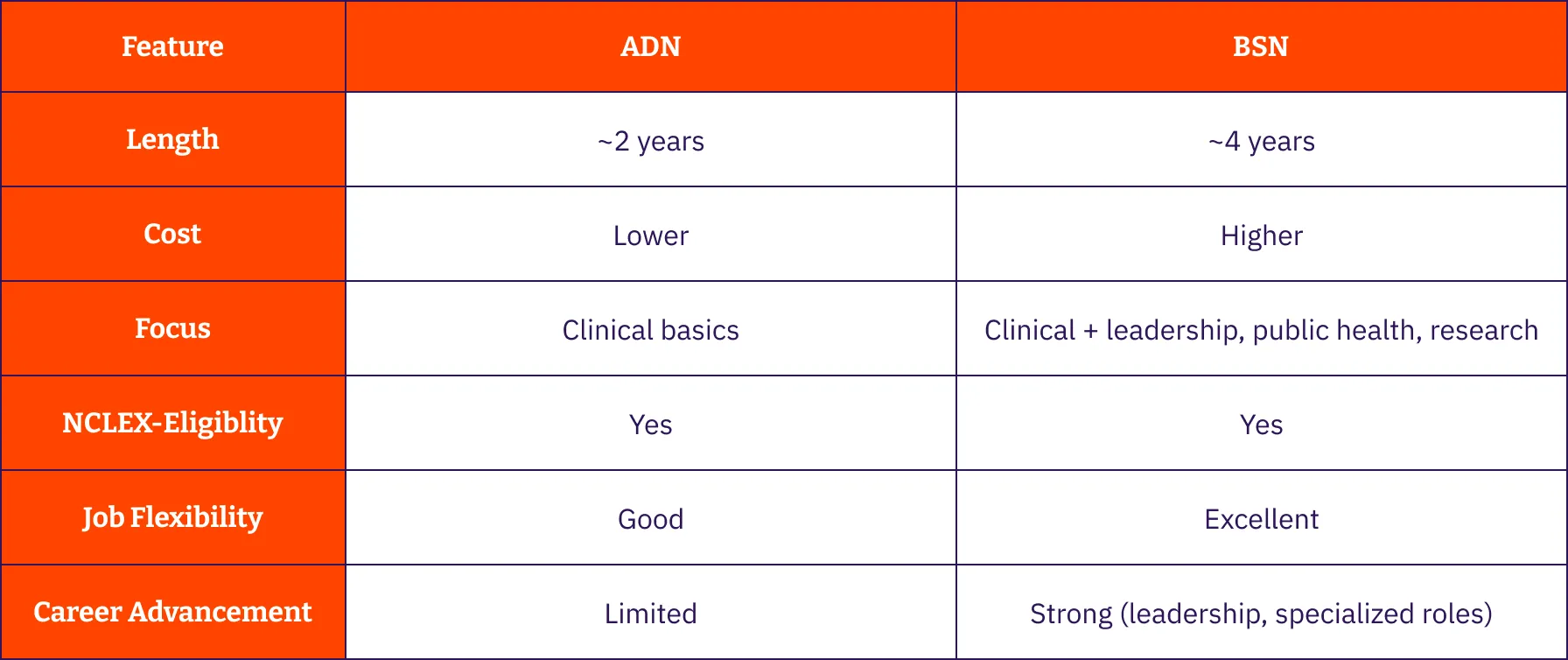
ADN vs BSN: Program Overview
ADN (Associate Degree in Nursing)
An ADN is a 2-year program typically offered at community colleges. It prepares students with the essential clinical skills needed to provide patient care. Many students choose this option because it’s quicker and more affordable, allowing them to enter the workforce sooner.
An ADN is best for:
- Students wanting a fast, cost-effective path to becoming an RN
- Career changers starting from scratch
- People planning to bridge to a BSN later
BSN (Bachelor of Science in Nursing)
A BSN is a 4-year degree offered at colleges and universities. Along with clinical instruction, BSN programs include coursework in research, public health, management, and leadership.
Because of this broader education, BSN graduates often have more job options, particularly in hospitals seeking Magnet status or in advanced-practice tracks.
A BSN is best for:
- Those seeking leadership or specialty roles
- Students who want higher long-term earning potential
- Nurses planning to earn advanced degrees (NP, CRNA, CNS, etc.)
Job Opportunities: Do BSN Nurses Have an Advantage?
While both ADN and BSN graduates take the same NCLEX-RN exam, many employers—especially hospitals—are increasingly preferring or even requiring BSN-prepared nurses.
In fact, some health systems have adopted “BSN in 10” policies, encouraging or requiring nurses to earn a BSN within 10 years of licensure.
Common Jobs for ADN Nurses
- Staff RN (most bedside units)
- Long-term care nurse
- Clinic nurse
- Home health
- Rehabilitation nursing
Common Jobs for BSN Nurses
(In addition to ADN opportunities)
- Charge nurse
- Public health nurse
- Case manager
- Nurse educator (entry-level roles)
- Leadership and management positions
Salary Comparison: Do BSN Nurses Earn More?
Yes—on average, BSN-prepared nurses tend to earn more over time, largely because they qualify for higher-level positions. Starting salaries may be similar, but career-long earnings typically favor BSN nurses due to advancement potential.
Which Degree Is Right for You? Key Questions to Ask
1. How fast do you want to start working as a nurse?
If speed is your priority, the ADN is the quicker path.
2. What’s your budget for nursing school?
Community college ADN programs cost significantly less upfront.
3. Do you want nurse leadership or specialty roles?
If your goals include ICU, ER, flight nursing, management, or becoming a nurse educator, a BSN is the stronger choice.
4. Do employers near you prefer BSN-prepared nurses?
Major hospital systems increasingly do.
5. Would you consider an RN-to-BSN bridge later?
Many nurses get their ADN, start working, and complete their BSN online while earning income.
The RN-to-BSN Path: A Popular Middle-Ground
For many, the best option isn’t choosing one or the other—it’s doing both in stages.
This approach allows you to:
- Start working as an RN sooner
- Gain clinical experience
- Earn a higher degree later with employer tuition reimbursement
- Spread out the cost over time
RN-to-BSN bridge programs are typically flexible, online, and designed for working nurses.
How Achieve Test Prep Fits Into the ADN vs BSN Decision: Bridge Programs & Support
If you’re considering nursing school but want a more flexible or accelerated path — or if you already have a healthcare background and are thinking about returning for an ADN or BSN — Achieve Test Prep offers nursing bridge programs to help streamline the process.
What Achieve Test Prep Does
- Prerequisite and general-education “credit by exam” prep. Instead of spending a semester inside a classroom for general-ed courses (like math, composition, psychology, etc.), Achieve offers courses preparing you to earn credit by exam (such as CLEP or DSST). Passing these exams lets you “test out” of those courses and skip them — which means fewer semesters and less time before you begin core nursing coursework.
- Entrance exam preparation for nursing school. If your nursing program requires entrance exams (e.g., TEAS, HESI, etc.), Achieve offers live, online interactive prep to help you pass.
- Tutoring and support during nursing school. Once you enter an accredited college that grants an ADN or BSN degree, Achieve offers on-demand tutoring and mentoring for your core nursing courses.
- NCLEX-RN preparation. To become a Registered Nurse, you need to pass the NCLEX-RN. Achieve offers an NCLEX prep course focusing on the most important and frequently tested content.
- Flexible schedule for adult learners and people working while studying. Because many of our prep courses are online and often structured around exams rather than full-semester courses, Achieve provides flexibility for students who are working full time, caring for family, etc.
In short: Achieve doesn’t grant an ADN or BSN. Instead, we aim to shorten or simplify the path to one by helping students earn transferable credits, pass entrance exams, and prep for the NCLEX.
How This Can Affect the ADN vs BSN Decision
Using a service like Achieve can influence your decision in several ways:
- If you want to start nursing school quickly and affordably (leaning toward ADN), Achieve can help you skip many general-ed prerequisites — which reduces both time and cost.
- If you plan to eventually earn a BSN, but don’t want to spend 4 full years at a traditional college/university, Achieve might help you fast-track the general-ed portion, enabling you to begin your core nursing or BSN courses sooner.
- For working adults or people with nontraditional backgrounds (career changers, parents, etc.), the flexibility and credit-by-exam approach can make returning to school more manageable.
- Because Achieve supports both pathways, it can serve as a bridge — helping students move toward an ADN or BSN while balancing life-work-school obligations.
When Achieve’s Bridge Program Might Be a Smart Choice
If you fall into one of these categories, Achieve’s model might be especially appealing:
- You want to enter nursing school ASAP, without waiting years to finish lots of prerequisites.
- You are a working adult, parent, or otherwise busy — but you still want to become an RN or get a BSN.
- You value flexibility and being able to plan your education around work or other life responsibilities.
How This Shapes the Big Question: ADN or BSN
Given everything above, the “ADN vs BSN” question might look different if you include the possibility of using a bridge/test-prep program:
- If speed, affordability, and flexibility are your priority — ADN via a bridge-style path (with help from Achieve) might be the best entry point.
- If you know you eventually want a BSN (or advanced practice), but can’t commit to a full four-year traditional program — starting with bridging help then finishing a BSN might be a viable “best of both worlds.”
- If you want maximum long-term flexibility, specialized nursing roles, or wish to pursue graduate-level nursing later — combining RN bridge + eventual BSN could give a balance of accessibility and credential value.
So… Is It Better to Get an ADN or BSN?
There is no one-size-fits-all answer. The “better” degree is the one that aligns with:
- Your career goals
- Your timeline
- Your financial situation
- The type of nursing work you want to do
- Local employer requirements
If you want to enter the workforce quickly and affordably → ADN may be best.
If you want long-term growth, leadership roles, or specialization → BSN is the stronger choice.
Many nurses start with an ADN and later complete a BSN to keep their options open. The choice is yours but either way, earning your degree and becoming an RN is a great career move.
Take the next step
Move towards your education and career goals in less time with more supportive, flexible programs built for busy, working healthcare professionals.